Showing posts with label Clay Plaster. Show all posts

Tuesday, November 1, 2016

Pigmented Clay Plaster

The plan all along was to use a pigmented finish clay coat as the finished color of the Light Straw Clay walls.  I have enjoyed working with the American Clay products.  They have an easy to follow system, an extensive array of colors to choose from, and best of all--excellent instructional videos on their website.

I'm doing two coats: the first has one packet of pigment per bag of LOMA clay.  This is the roughest mix they have, and is a good base for the final layer, which is finer-grained (Porcelina, in my case).

One tip they list is to use a 7-gallon mixing bucket to avoid creating a mess during the mixing process.  After looking into it, I found this would be hard to source, and relatively expensive.  It turns out, I had a 5 gallon bucket that I had already cut the bottom off of.  Problem solved for free!  I just stuck this in the black bucket and had no trouble mixing, even though I didn't caulk the white extender in place.
You can see the plaster going on, with the darker sections at the bottom right.  This layer is only the thickness of a credit card (about 1 millimeter).  Despite pre-wetting the clay, the clay layers were drying so fast that it was hard to blend the fresh plaster into the previous row.  Perhaps colder temps (it was in the mid 70's and pretty dry), or a better pre-wet would help with this.  Lessons learned for the final layer.  Three test spots are visible on the right.

Here is a closeup of the three test patches in cool, morning light.  The one on the right is what I placed on the walls: one bag of pigment to one 50 pound bag of plaster mix.  Middle is two bags of pigment, and the left is three.

Same test patches in warmer afternoon light.  What would you pick?  I'm going with the middle one.
This shows the first corner at the end of the day, with the sort of splotchy drying in progress.
And the same area fully dried in warm evening light.  With a flash, this looks very washed out, so I didn't include that photo. 

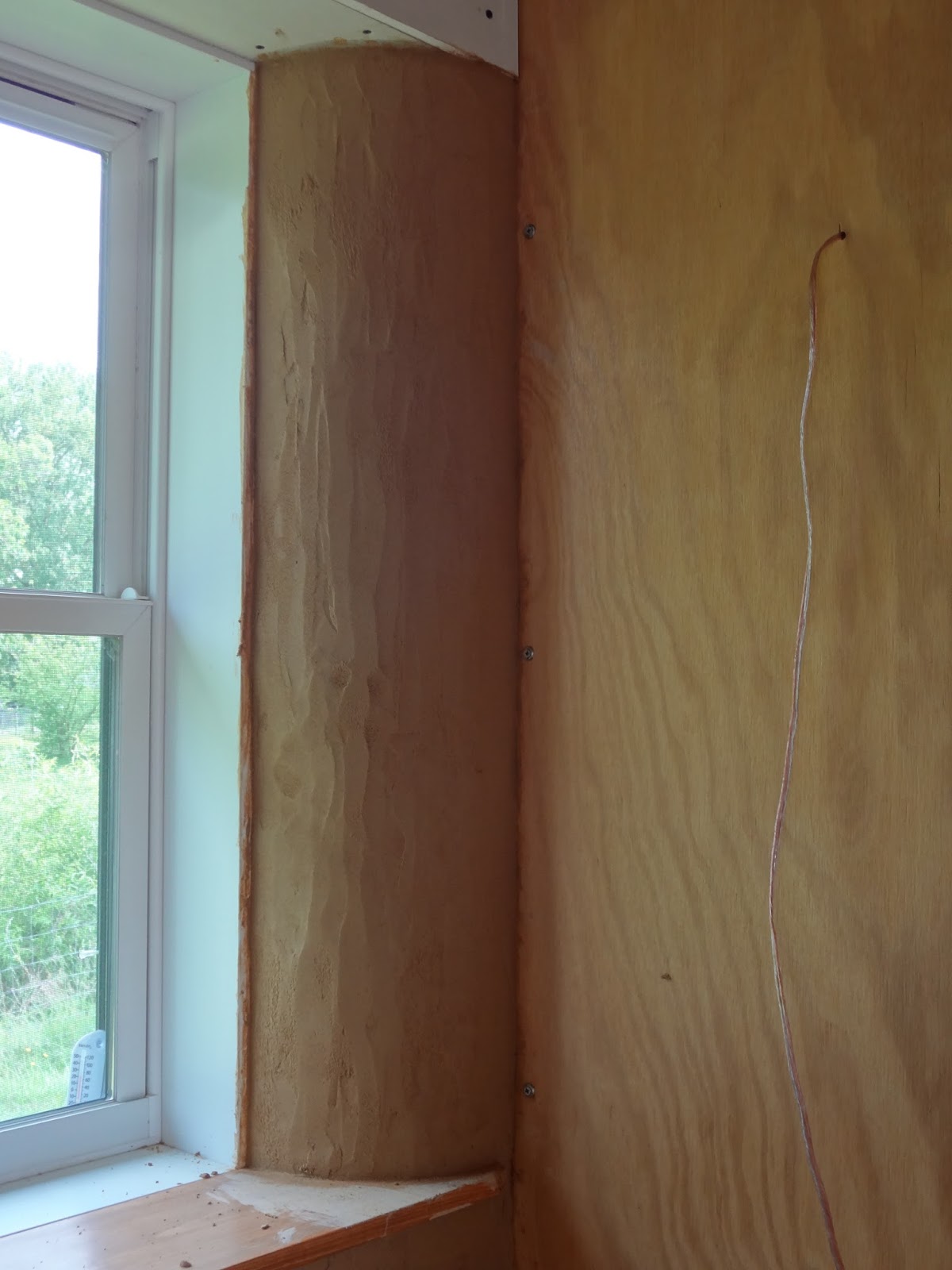
I'm quite pleased with how the transition came out between the drywall above the window and the clay plaster on the Light Straw Clay.  Thanks to Kate for the glass art!

Wish I'd cleaned off the window sill for the picture.  I wanted the wood to protect the corner, figuring it would be prone to damage.  In the end, I think I prefer the look of the solid wood window sill that I built in the kitchen and bathroom.
This is also a preview for the next post: Tadelakt


Tuesday, June 28, 2016

Clay Plaster Straightening Coat is DONE!

There's not a lot for me to say about these, but note that I used a flash which washed out the clay color a bit.  It's browner and warmer than it looks here.  The final thickness is about 3/8 of an inch and I'd estimate that it's flat to within 1/8 of an inch.  The idea isn't to get this layer picture-perfect.  #1, that would involve much more skill than I have, and certainly more patience.  #2, the final pigmented layer will cover up the blotchiness and some of the smaller imperfections.  #3, clay plaster is supposed to have natural variations and texture: it's organic, not manufactured.

Looking northeast (future kitchen)

North wall with blocking for wall cabinets

Looking northwest

West wall

Note the wet clay (darker) on the South wall to the left

South wall

Closeup of a window round before final smoothing

Detail around the electric panes, showing the transitions to drywall.
These will get further smoothing with drywall mud

This is how I blocked out the truth window.  The plexiglass is screwed in,
and this 1/2 thick styrofoam form is taped in place to allow me to create a clean
line with the straightening coat.

Porthole screwed in place on top of the still-soft straightening coat to
mold the clay to fit to the metal rim.

Porthole closed
(See what the clay looks like in natural light, rather than with a flash?)

Saturday, April 23, 2016

Clay Plaster - Scratch Coat

I'm finally starting on the clay plaster!  I've enjoyed the Light Straw Clay (LSC), but I've also been looking forward to covering it up.

This is the before photo.  Note the 3/8" plywood at the top of the wall covering the blocking for the kitchen cabinets.  The plaster will be flush with this.

 luckily, the mortar mixer fired up after several months of non-use without major drama.  Clay: this is the same clay soil I used for the floor, screened through 1/2 wire mesh, soaked in a bucket for several hours (several days is better), and given a preliminary mix with my double auger mixer.  Concrete sand (vs masonry sand)  is used because it has varying grain sizes that lock together more compactly.  I'm still not sure about the wheat paste: it didn't seem to make the mix stickier or more workable, as is claimed.  That will warrant some further experimentation.  One mix is enough to keep one person busy for the rest of the day. This turned out to be five 5-gallon pails filled 1/2 full.

Ready to start applying.  The LCS has been pre-wet to the right of the taped electrical box.  I used my paint sprayer, just spraying potable water and that turned out to be a great way to get controlled coverage (and good for me to practice my wrist technique).  I made one pass 10 minutes or more before stariting, and a second pass right before plastering.  I started out using the trowed to apply the plaster to the wall, but we quickly found that hands work better.

Two sections done.  This is called the scratch coat, as I'll explain later.  The goal is to get the best possible adhesion to the LSC, so we paid the most attention to pressing the plaster into the interstices of the LSC. Apply a handful smearing it up the wall.  Get a section roughly coated, and then come back and press it down with a sort of jiggly motion to lock it into place.  (Same as applying lime plaster to lath.)  The downward motion leaves some lumpiness that is easy to smoothout with some light upward or sideways strokes.  

We put some effort into leaving a uniform thickness, which is really pretty easy if the wall was well formed.  These sections were quite flat, but some later sections were less regular, so the scratch coat sort of half evens out the variations.  The straightening coat, coming next, will finish that process.  This scratch coat was only just thick enough to cover the majority of the straw.  Just a few stalks are left visible on the surface.

The corner was a bit of an experiment.  I started from the top with expanded metal lath stapled into the wood studs.  The lath started out thick at the top (3" per wall) and got progressively thinner toward the bottom.  You can see about 2" per wall in this photo.  The very bottom involved burlap placed into a thin layer of wet plaster.  You can see that it's pretty wavy, and it was a pain to get it to wrap the corner, so I'm leaning toward the lath as my final solution.  Since this corner is in my pantry closet, I'm less concerned with the look of it.

Regarding the exposed studs, I will deal with them with the straightening coat.  First, I'll place a skim coat of plaster over the wood, bridging the adjacent scratch coats.  Then I'll press a 6" strip of burlap into that wet mix and let it dry for several hours or perhaps overnight.  Then I'll come back  and lay the scratch coat over the entire wall, getting it as smooth and level as I have the desire and patience for.


 So that's what we completed by the end of the day.  Not too shabby, and more rewarding than the adobe floor, which involved a lot of loud mixing and laborious troweling.Clay plaster is still laborious, but at least you are standing up about 2/3 of the time.

The final task is to scratch up the surface to give leave a good texture for the next layer to adhere to.  Unfortunately, my closeup photos didn't come out.  At Bob's suggestion, I tried out a hair pick and it was the perfect tool!  Just pull horizontally and you get a nice pattern of 1/16" to 1/8" grooves.  I tried a diamond pattern, but that seemed to rough up the mix too much.

This is the wall after two days of drying.  I find it interesting that two of the sections are notably wetter than the others, since they all seemed to be the same thickness of clay.  I guess not.  In the  darker panels, you can see the scratch patterns: diamond on the left, and horizontal on the right. After 4 days, it was completely dry.  Interior conditions were in the low 60's with relatively low humidity.


Tuesday, March 22, 2016

Drywall above the Windows

The interior walls, made of light straw clay (LSC), will be covered in clay plaster.  For the finish coat, I've decided to use an American Clay, pigmented product.  This should make for an easy and predictable finish coat.  I really like how informative their website is, complete with detailed videos.  Check them out at americanclay.com.

I've mentally tried out various techniques to deal with the areas above the windows and for the window sills.
This photo shows the plastic above the windows, which holds in the cellulose insulation.  This needs to be covered before I can plaster it.  Since American Clay can be applied over drywall, I decided that would be a relatively easy way to create a uniform finish coat, with a consistent look over both the LSC and the drywall.

Above the kitchen window, the drywall (and later, the finished plaster) gets notched for the I-beams, which are exposed.

This is a test section of ceiling showing the brown beams and off-white ribbed panels.

Above the closet, the beam (still unpainted here) runs along the top of the drywall and marks the top edge of the clay plaster.  The off-white panels will sit on top of this beam.

This shows the south windows.