Showing posts with label Fun Stuff. Show all posts

Monday, January 14, 2019

Snow Glacier on My Roof

One cool product on the Practice House that I really love are the Rainhandlers, which take the place of traditional gutters.  I’ll give you a technical discussion of rain handlers below, but first I wanted to share pics of last night’s snow sheeting off my metal roof, curving around the Rainhandlers, and freezing in place.  Fun stuff!


There are so many downsides to gutters, but top of the list for me is the PIA factor to clean them out, and the fact that they can hide or exacerbate rot and other problems relating to the fascia trim at the edge of a roof.  On a new structure, if you’re willing to install them yourself (which is easy if your roof is easily accessible), they are more affordable than traditional gutters as well.

With Rainhandlers, in a nutshell, rain that sheets off the roof, hits a series of curved blades (similar to venetian blinds) and sprays out in a fan pattern rather than dripping down in a straight line.  This avoids creating a washout under the edge of a roof that has no gutter, and it avoids concentrating flow from a traditional gutter/downspout that may lead to erosion around your foundation.  Spreading out roof runoff is an important principle of low impact development, so in jurisdictions where houses are subject to stormwater management regulations, this may reduce or eliminate the need to build treatment practices like rain gardens.  For more info, check out rainhandler.com

(Incidentally, the closeup shot also shows off the fabulous job the carpenters did with the trim under the roof overhangs.)

Wednesday, December 5, 2018

Coat Hooks

Sorry for the long silence!  I've been distracted with other projects, lots of work, and a long sailing adventure, but I'm starting to devote some more time to finishing up the little details of the interior.  Here is the coat rack I just installed:


The wood assembly is made of stained pine, which mimics the other trim in the house.  Three metal hooks are screwed to the wood, and the whole assembly is screwed to the wall.  This is not particularly noteworthy, but if offers an opportunity to talk about various procedures to hang things on the walls in a natural house.

Reminder: the interior walls have about 1/2" of clay plaster on top of 3.5" of Light Straw Clay, which is packed between conventional 2x4 studs.  This is somewhat analogous to drywall in that if you want to hang something heavy, you'd better find a stud.  Clay plaster by itself, like drywall, is limited in the weight it can safely support.

The coat rack may have to carry 15-20 pounds, so it is screwed into two studs.  Fortunately, I was thinking ahead and marked all the stud locations before plastering over them.  In my house, you just need to push up the ceiling panels, and my marks are visible in the plywood that lines the perimeter of the cavity between the first floor ceiling and attic floor.  Use a plumb bob to project the marks down to the portion of the wall where you are looking to drive a screw.  (Fortunately, I hired expert framers and this house is amazingly square, level and plumb!)

I used 2-inch long #8 screws that are counter-bored into the pine, meaning they bite 1" into the studs (1" bite + 1/2" of plaster + 1/2" of wood = a 2" screw).  1" of bury is more than really necessary, but 1 1/2" screws would have only had 1/2" of bury, and that would have left me a little nervous.  I drilled a pilot hole for the screw and didn't bother with drilling a clearance bit through the plaster--it is soft enough that the screw drives right through the plaster with minimal effort.

I've only hung a few pictures and paintings where the weight is carried by the plaster.  The super-light one is just hung on a nail.  The medium one is on a standard hook nailed into the plaster, and the biggest, heavy painting has twin hooks nailed into 2 studs.  My intuition says that the clay plaster has maybe 1/2 to 2/3 the carrying capacity of drywall, which means you should choose a bigger nail/hook than you would for a conventional wall.

There's nothing significant about any of that, except that I was a little nervous about nailing into the plaster, worrying that it might be brittle and crumble.  Point #1 is that I did the nailing in the summer when the air is more humid and perhaps the clay is a softer and less brittle.  Point #2 is that I used a small paintbrush to wet the wall where I was going to drive the nail.  And I kept re-wetting it every 5 minutes or so for 20-30 minutes to pre-soften the clay.  At this point ,the nails drove in quite easily, and I let the clay dry completely before hanging the art on the hook.

With this methodology, it took a little longer to hang the art than it would have with a conventional drywall wall, but there have been no oh-crap moments.  If I had mock-up Light Straw Clay and drywal wall sections, I would do some destructive testing where I installed different size nails and hooks and hung weights on them until the fittings pulled out.  Alas, I wasn't thinking ahead on that, so that will have to wait until the next project.


Tuesday, June 20, 2017

Toilet Hand-Wash Basin

One of the space-saving features in my bathroom is that there is no sink.  There are toilets for sale that incorporate a hand-wash basin in the back of the toilet (check out caromausa.com).  When you flush, the water that refills the tank is routed through a faucet, giving about 30 seconds to wash your hands before the tank is full and the flow shuts off.  The basin simply drains into the tank, meaning the grey water from washing your hands is used for the next flush.  There are also kits for sale that allow one to retrofit most toilets in a similar fashion.

I ended up building as solution that functions the same way using an Ikea salad bowl as the basin.  I like that I have a shelf the entire width of the bathroom to maximize the amount of available horizontal space.


Building Codes require that a bathroom have a sink available with warm water.  This turned out to be the only sticking point in getting my building permit since a conventional toilet is only plumbed with a cold water supply line.  The solution was to add a mixing valve so the water that fills the toilet tank via the faucet is automatically mixed to come out warm.  This should have the benefit of keeping the toilet tank from sweating as much in the summertime.  One unintended and undesirable consequence of this is that the valve seems to reduce the pressure to the faucet, so it is pretty much just a trickle when it comes out.  The video shows it in action, but be aware that I didn't shoot for the entire 30-second fill cycle in case you don't have sufficient bandwidth to download a long video.


Tuesday, April 25, 2017

Miscellaneous Interior Tasks

After getting the water and sewer connected in February, I've been ticking off the list of things that need to get wrapped up before I place the final layer of adobe floor:

  1. Trowel on and smooth out the finish pigmented coats of clay plaster on the wall
  2. Have the plumber fit out the water heater, toilet, shower, etc.
  3. Have the electrician finish installing plugs, lighting, etc.
  4. Fit and install the ceiling panels
  5. Install the threshold at the entry door
  6. Hang interior door (there's only one!) and install door handle
These tasks are not quite wrapped up, but I'm getting close.  Here are some visuals:

Ready for action

I just need a rod and shower curtain and I'm ready to go.

Bathroom ceiling before curtain rod.

This part of the ceiling is finished--just a few more
panels to fit behind the camera.

Oak threshold at the entry door.  You can see that the final layer of adobe mix
will bring the floor level up about 3/4" to be even with the threshold
Clay plaster walls are finished.  Note the truth window on the right side,
where you can peer into the interior of the wall and see the
light straw clay infill between the wood studs.


Friday, April 21, 2017

A New Appreciation

Most of us have a tendency to take everyday things for granted.  Like when you sprain an ankle--the ability to walk comfortably anywhere you want seems like a luxury when you're hobbling up and down stairs on crutches.

I found the same to be true regarding a flush toilet.  Roughly nine months after I initiated my sewer and water hookups, I have a newfound jolt of satisfaction when I push that silver handle down.  


Tuesday, January 26, 2016

Snowzilla Aftermath

I stopped by Monday around noon to see the effects of the big blizzard on Saturday.

No drama here: the only thing of note was the pile of snot what had slid off roof.
But there was no damage to the Rain Handlers, so that's good news.

There's melting going on with the snow that drifted onto the porch roof.

Friday, January 15, 2016

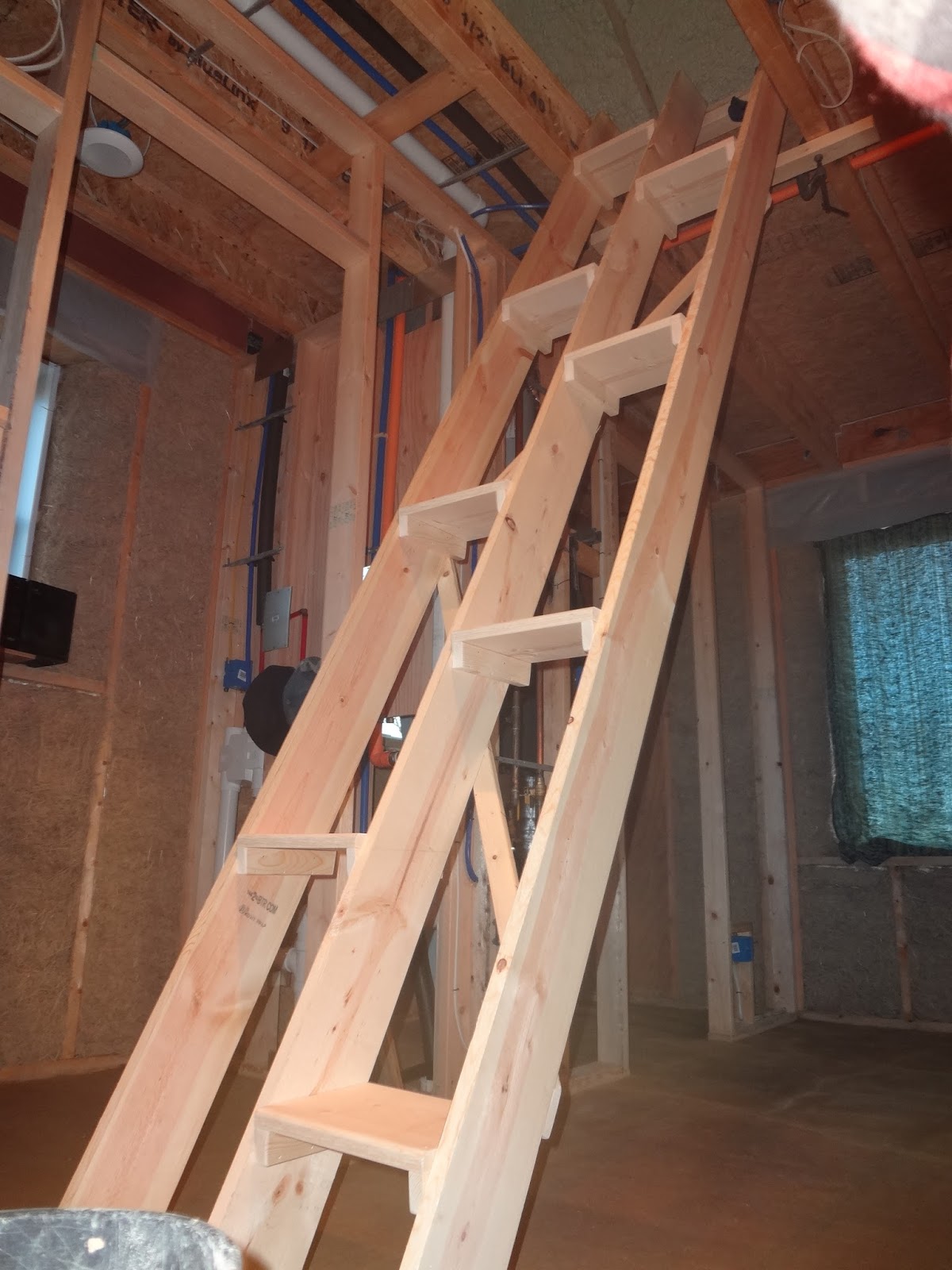
Alternating Step Ladder

An important part of my plan to keep the downstairs un-cluttered is to lean on attic storage.  As a result, I expect to be making multiple trips upstairs (or up-ladder in this case) every day.  A conventional ladder would be inconvenient in that you need at least one hand to help negotiate the ladder, so carrying stuff would be a real pain.  I obviously don't have room to spare for a conventional staircase, hence, I've built an alternating-step ladder:

 Pictures are one thing, but the below below is probably much more instructive.  Note that I'm hands-free going up and down.  (For illustrative purposes, I should have held an ice cream cone in one hand and an open beverage in the other.)